
Rotational Molding Process & Applications
HOME / Products
Rotational molding, also known as rotomolding or rotary molding, is a low-pressure thermoplastic manufacturing process used to produce seamless, hollow plastic parts with complex shapes and uniform wall thickness.
Rotational molding is particularly suitable for large, hollow and geometrically complex plastic components. The process offers excellent design flexibility, relatively low tooling costs, high material utilization and seamless one-piece construction.
From automotive fuel tanks and bumpers to industrial containers, protective enclosures and customized hollow components, rotational molding provides an efficient solution for manufacturing durable plastic products.
What is the Rotational Molding Process?
Rotational molding—also known as rotomolding or rotary molding—is a process in which plastic powder is loaded into a mold; the mold rotates along two perpendicular axes while being heated, causing the material to melt and coat the inner walls of the mold cavity evenly; a hollow product is obtained after cooling and solidification.
How does the Rotational Molding Process Work?
The rotational molding process generally consists of four basic stages:
1. Material Loading
A measured amount of plastic powder or resin is placed inside the mold. The material quantity is determined according to the required product weight and wall thickness.
2. Heating and Biaxial Rotation
The mold rotates around two perpendicular axes while being heated in an oven. The plastic material gradually melts and coats the internal surface of the mold.
3. Cooling and Solidification
After the required heating cycle is completed, the mold is transferred to a cooling station. Cooling may use forced air, water mist or a combination of cooling methods while the mold continues to rotate.
4. Demolding
Once the plastic has sufficiently cooled and solidified, the mold is opened and the finished product is removed.
Material Loading → Heating & Rotation → Cooling → Demolding
Rotational Molding Applications
Typical applications in the automotive sector
Fuel tank: High design flexibility allows it to conform to the chassis space; impact-resistant and leak-proof.
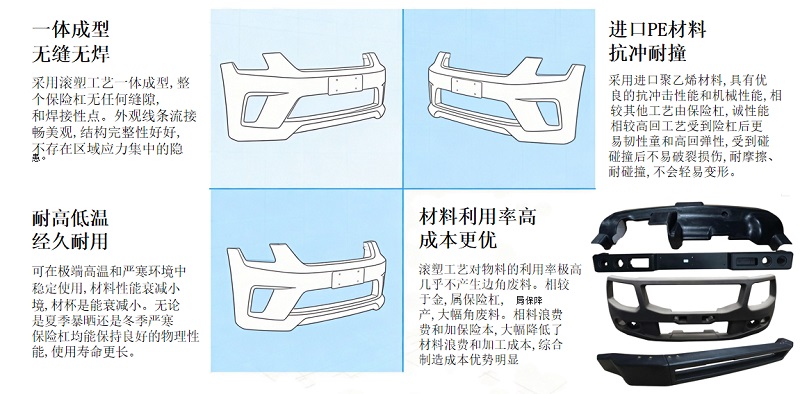
Bumper: One-piece molded construction with high toughness; excellent impact resilience, lightweight, and corrosion-resistant.
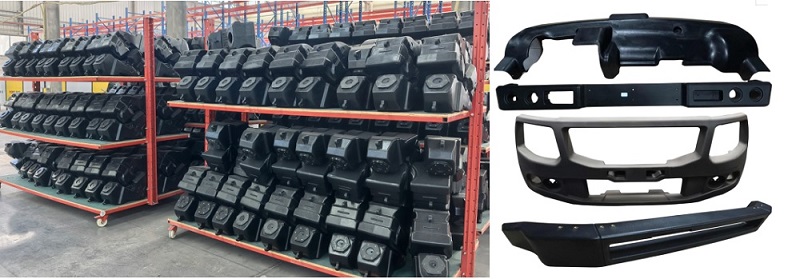
Rotational molding of automotive fuel tanks
Manufacturing Features: Automotive fuel tanks are produced using imported polyethylene (PE) material via a one-piece rotational molding process. Complex, non-standard curved shapes can be designed to fit the chassis space of specific vehicle models, maximizing the utilization of available structural space; the seamless, one-piece construction eliminates the risk of leakage associated with welded joints.
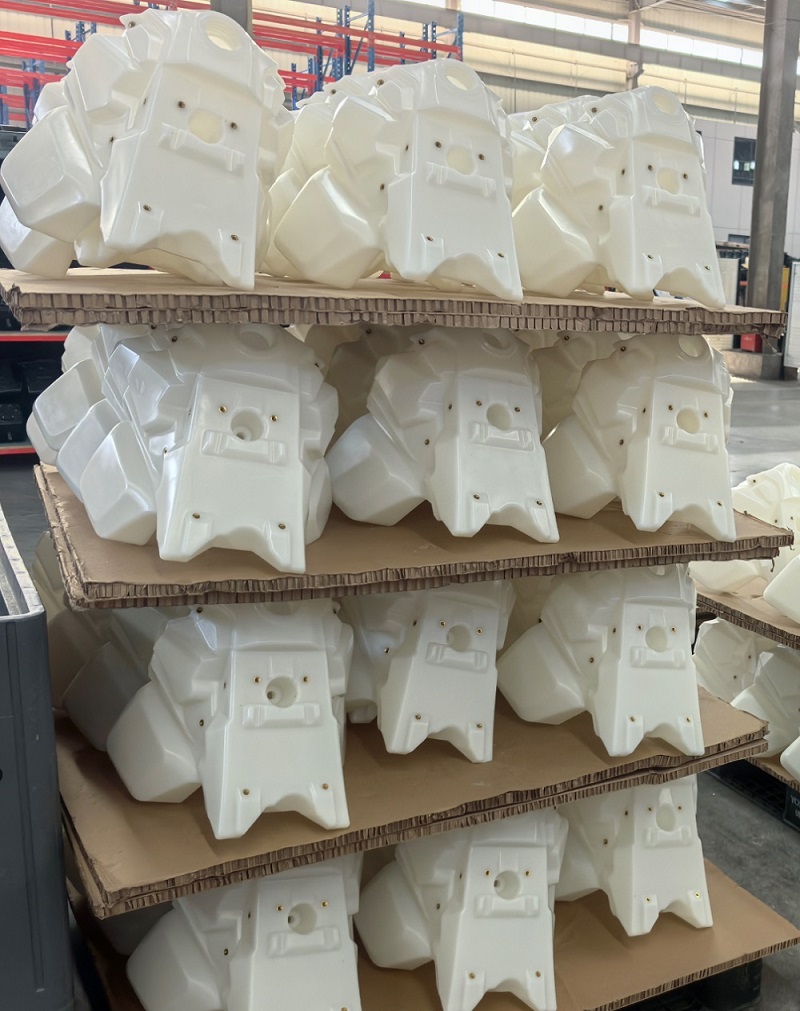
Rotational molding of automotive bumpers
Rotomolded bumpers are plastic bumpers manufactured as a single, seamless unit using the rotational molding process. They are primarily made from imported polyethylene, with the material evenly coating the mold to form the shape as it rotates and heats. The product is free of welds and seams, offering excellent structural integrity and sleek, fluid lines.
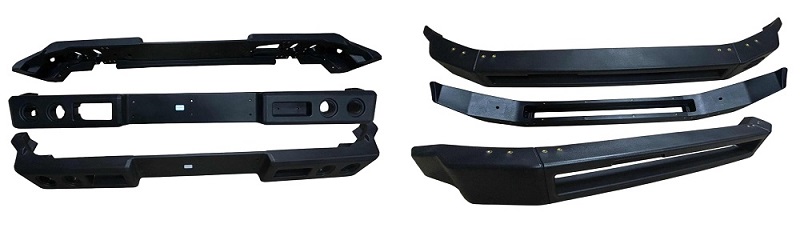
Key Advantages of Rotational Molding
One-piece, seamless molding;
High product strength and low internal stress;
Low mold costs; suitable for large and medium-sized, complex hollow parts;
Capable of producing double-layer and multi-layer structures with uniform, adjustable wall thickness;
Virtually no trim waste, resulting in high material utilization.
Rotational Molding FAQ
What is the rotational molding process? What are the basic steps involved?
Rotational molding (or rotomolding) is a thermoplastic molding method used to manufacture hollow plastic products. Powdered resin is placed inside a mold, which is then rotated biaxially—spinning around two perpendicular axes—inside a heating oven. The plastic powder melts from the heat and coats the inner walls of the mold evenly; after cooling and solidifying, the mold is opened to remove the finished product.
What are the main differences between rotational molding, blow molding, and injection molding?
Pressure: Rotational molding is a zero-pressure or low-pressure process, whereas blow molding and injection molding require high pressure for injection or inflation.
Wall thickness distribution: Rotational molded parts have very uniform wall thickness, and outer corners do not thin out (in fact, they are often thicker); in contrast, blow-molded parts tend to thin out in areas subject to significant stretching.
Mold cost: Rotational molds do not withstand high pressure and are typically made of cast aluminum or welded steel plate, making their cost far lower than that of injection or blow molds.
Suitable products: Rotational molding is ideal for large, extra-large, and structurally complex hollow products—whether fully enclosed or semi-enclosed (e.g., large water tanks, kayaks, rotomolded cases, etc.).
What are the most commonly used plastic materials for rotational molding?
Polyethylene (PE): Accounts for over 85% of rotational molding materials, including LLDPE (linear low-density polyethylene), HDPE (high-density polyethylene), and XLPE (cross-linked polyethylene).
Other materials: Polypropylene (PP), polyvinyl chloride (PVC plastisol), nylon (PA), and polycarbonate (PC).
What are the wall thickness limits for rotational molded products?
Standard wall thickness for rotational molded products typically ranges from 2 mm to 12 mm, though specialized industrial parts can exceed 25 mm. Since the process relies on heat conduction to melt the material, excessive wall thickness can lead to overly long heating cycles and material degradation or aging.
What draft angles should be considered when designing rotational molded products?
Flat external surfaces: A draft angle of 1°–2° is recommended. For internal bosses or deep grooves (which tend to grip the mold tightly as the plastic cures and shrinks): A draft angle of 3°–5° is recommended.
If the surface is textured (e.g., leather grain), the draft angle must be increased by 1° for every additional 0.025 mm of texture depth.
Common Product Defects and Solutions
Surface Pinhole Defects (Pinholed Surface)
Causes: Insufficient mold heating temperature or duration; powder particles are too coarse or contain moisture.
Solutions: Extend heating time; increase oven temperature; ensure material is thoroughly dried; use finer mesh powder (typically 35-mesh standard powder).
Part Warpage or Distortion (Warpage)
Causes: Uneven cooling (e.g., one side of the mold cooling too quickly); demolding too early during the cooling process; or highly uneven wall thickness.
Solutions: Adjust cooling fans and water mist nozzles to ensure uniform cooling rates across all sides; maintain the mold in the cooling station until the product temperature drops below the deformation threshold before demolding.
Uneven Wall Thickness (Uneven Wall Thickness)
Causes: Mismatched rotation speed ratio (Rotation Ratio) between the mold's major and minor axes, leading to uneven powder distribution inside the mold.
Solutions: Adjust the speed ratio (common standards are 4:1 or 3:1, requiring fine-tuning based on part geometry); apply pre-heating or insulation to the mold's outer wall in areas prone to thin spots.
Poor Impact Strength / Brittle Material (Part Brittle / Low Impact Strength)
Causes: Over-cooking (causing thermal-oxidative degradation of the polymer) or under-cooking (powder not fully melted and densified).
Solutions: Use an internal air temperature monitoring system (e.g., in-mold temperature sensor or RotoLog) to precisely control the peak internal air temperature (IAT), ensuring the resin fully gels without burning.
PRODUCT FILTER
PRODUCTS&STORE
- TURBINE HOUSING SHIELDS
- Silicone Hose
- Heat Shield Management
- CNC Products
- Chassis Drifting Parts
- Carbon Fiber
- Auto Transmission System
- Exhaust System
- Cooling System
- PA Tube and Assembly Series
- Wastegates/External Wastegate
- FUEL PUMP
- Tianium Exhaust Pipe
- Standard Exhaust Pipe
- Auto parts tools
- Heavy Duty Ramp
- Wheel Series
- ADI Casting
- Rotational Molding Process
-
Address:
Hangzhou Haihua I & E Co. LTD
2nd Floor, B Building, Jinrun Technology Park,
399 Qiuyi Road,Binjiang District,
Hangzhou,310052, China -
Tel: +86-571-85463038
-
Chinese Phone:+86-139-5717-0353
-
US Phone:+1-626-493-9520
-
Fax: +86-571-85464084
-
E-mail: sales@hiwowsport.com
-
Connect : Andy Ying
-
Whatsapp: 008613957170353
-
kuaishou:hiwowsport2005
Tik Tok(Chinese version):dy9zc1x1bwtp
Xiaohongshu:racingcarparts
kuaishou:hiwowsport2005